Hello! My name is Yi Jin, you can call me Jeni as well 🙂
Contents



2.Autobiography & Literacy Narrative
<An opportunity to choose engineering>
I am a girl from China, and my name is Yi Jin. My major is electronic and computer engineering. I have been educated in China from primary school to high school, however, a series of things happened during this period made me obsessed with engineering, and let me choose this major.
By the end of the 10th grade, all students were supposed to choose academic tracks according to their interests and academic preferences. That’s when our chemistry teacher, Mr. Hu, declared that he did not want girls to continue to take his classes because chemistry was “not for girls.” I saw some other girls nod. I was furious, but also a little frustrated because it reminded me of my family business.
My family was running a business in electronics. I wanted to tell Mr. Hu that he was wrong— that women could be good in chemistry, science, engineering, and everything. I wished that I could say I had proof because the female members of my family were in charge of the research and development of the products. But that was not the truth. My father had always insisted that females were not suited in science and engineering, but my sister and I remained unconvinced. She eventually disproved his theory by attending Rutgers, where she took courses in electrical and computer engineering.
On summer vacations, I stayed in the lab with my dad almost every day. With the motivation provided by my sister’s success in engineering , I designed a couplant heating system and successfully applied for four patents of my own, which gave me great confidence in my subsequent science studies.
Consequently, I chose to continue studying engineering courses. In the final exam of the 11th grade, I got the highest grade in chemistry. This confirmed for me that girls could think scientifically and excel in the science disciplines. Thus, I want to make further contributions to the field of electronics and make greater achievements.
In my life, writing and verbal exchanges are more than just tools of communication, they bring deep emotional support and rich human wisdom respectively. In the process of reading and writing, I gradually realized my own identity and mission as a reader and writer. And also, while travling, communicating in English with people from different countries and learning their languages made me feel the charm and wisdom of writing.
In my spare time,I always traveling when I was young. On the way of traveling, I often meet different friends. We will spend a wonderful holiday together and then return to our daily life, but I will miss them a lot. When I was young, I didn’t know how to express my missing, nor did I know how to contact them in the future. At one of my travel in Hainan, I met a good friend from HangZhou in China. We met in Hainan because of fate, travel together, and we experienced a lot of interesting things. Thus, she is special to me, and I miss them so much after leaving Hainan, but after a period of time I did not know how to contact them, because I didn’t have a cell phone in primary school. However, suprisely, I received a letter from HangZhou in the morning one day, and I had never received a postcard from a strange place before. And then I opened the envelope and saw writing written all over the back of the postcard, and I feel their yearning in her words. They wrote in the letter about her travel experience in Hainan Province and their concern for my current situation, because I once thought that they would forget me two months after the activity ended, but this letter makes me feel very warm. Writing is an expression of emotion, our feelings meet and light up each other’s lives and it makes people from different places care about each other and creates our fate. Now,We still write letters to each other.
In the same time, while travling aboard, communicating with friends from different cultural backgrounds was another valuable experience for me that let me feel the power of language. Through the common language of English, I have been able to communicate deeply with friends from all over the world and learn their language and culture. Whenever I learn a new language, especially when I try to communicate with my Spanish friends in Spanish, I not only understand their language, but also experience the unique wisdom of their culture. This kind of cross-cultural communication allows me to appreciate the diversity and richness of language, which is not only a tool for communication, but also carries the historical values and wisdom of a nation. For me now, I think language is the window of culture and the crystallization of human wisdom, which enables us to transcend national boundaries and understand and appreciate different ways of life and ideas.
When I was a child, I once inadvertently saw a book on the bookshelf called “Harvard Family Instruction”, which is composed of many small stories with different protagonists, telling us their different beautiful characters, teaching us a lot of truth, and making me understand a lot. This was the first time that I became obsessed with reading, and felt the pleasure of reading and the inspiration for my thoughts. I realized that I was a reader, and I had learned from the book what the author wanted to pass on to me.
When I was in junior high school, I was very fond of reading and writing, and I usually liked to write down my feelings after reading, trying to convey my ideas to readers. At that time I wrote an article about encounters, which told me about an encounter with books and the profound impact that books had on me with a little girl. This composition got a high evaluation and score from the teacher, so the teacher told me to show my composition in the school magazine. After seeing the feedback and comments of my classmates in the school magazine made me feel for the first time that not only reading makes me feel satisfied, but writing also allows me to express my thoughts and creativity.
As time went on, I kept reading different types of books and trying to write articles in various styles. From reading classic literature to creating my own short stories, I gradually found that I not only enjoyed the process of reading, but also enjoyed sharing my thoughts and stories with others through writing. This dual experience has made me more aware of myself as a reader and a writer.
Writing and language communication have played an extremely important role in my life. These words are not just symbols on paper, they contain deep emotion and invisible power. As a reader and writer, I realized that words in the books and letters not only gave me emotional support and gave people a window to express their feelings, but also impact a lot of people. The language learning and communication in foreign countries have made me realize the charm and breadth of wisdom of language. These profound experiences have made me cherish the rich experience and far-reaching influence brought by words and languages more. Thus,I will continue on this path of exploration to feel more of the charm of words and writing.

3.Narrative Writing Project
Peking Opera, the jewel of traditional Chinese dramatic art, is a combination of music, dance, martial arts and dramatic performance. Its history can be traced back to the late 18th century, then gradually developed into the main opera form of the Qing court, and reached its heyday in the 19th century. With its unique performance style and rich cultural connotation, Beijing Opera has become an important symbol of Chinese culture.
Dan, Jing and Chou, each with its own specific character and artistic expression techniques. Raw characters represent male characters, Sinian characters are female characters, pure characters are mostly painted faces to show military or loyal officials, and clown is known for humor. These characters show their personalities and emotions through voice, body, makeup and clothing, forming a unique artistic language.
Secondly, the music part of Beijing Opera is accompanied by Jinghu, Yueqin and other instruments. The melody is beautiful and full of rhythm, and the singing part is often rhythmic. This kind of clever cooperation brings a strong auditory enjoyment to the audience. Its content is usually based on historical stories, folklore and classical literature, and conveys the values and cultural spirit of the Chinese nation.
The first time I got close to Peking Opera was when I was in high school, when a Beijing Opera troupe came to our community to give a public performance. Their performance took place on a sunny afternoon in a lively setting. The actors wore gorgeous costumes with elaborate makeup on their faces, lights flashed on the stage, and the sounds of Musical Instruments echoed through the air. In the performance, the actors vividly interpreted the classic Chinese stories with elegant figures and touching singing voices. I was fascinated by their immersive performance, as if I were in an ancient situation. After the performance, I took the initiative to participate in their offline cultural exchange activities related to Peking Opera to personally experience the charm of Peking Opera. In the activity, I learned the simple singing and body movements of Beijing Opera, and also felt the performers’ deep understanding and devotion to their roles. Through the teaching of professional teachers, I have a deeper understanding of the essence of Peking Opera: the rich history and philosophical thoughts. This experience made me interested in Peking Opera and inspired my passion to explore traditional culture.
During the process of learning Peking Opera, I actually meet many problems about lack of cultural background and difficulty expressing emotions. Peking Opera is deeply rooted in traditional Chinese culture, with a rich historical background behind many of the performances and rituals. In the process of learning Peking Opera, I often felt unfamiliar with the repertoire and could not understand the meaning of the movements and customs in it, which made me feel very uncomfortable when talking and interacting with teachers and peers. In order to overcome this problem, I decided to ask the teacher to understand the historical background and culture of that period before each rehearsal, so that I could be more immersed in the performance and communicate with my peers more deeply. In addition,Emotional expression is also an important and challenging aspect of Peking Opera learning. In order to improve this ability, I have adopted several effective strategies.
First, I focus on a deep understanding of the character. Each character has a unique background and emotional experience. I spend time researching the characters’ stories before acting and try to feel their inner world. By reading the script and analyzing the psychological changes of the characters, I was gradually able to combine my own emotions with the emotions of the characters, so that I could express them more naturally in the performance. Secondly, I take an active part in performances and rehearsals. No longer afraid to show up for fear of screwing up. In the actual performance, I try to show emotion boldly, even if it is not perfect at first. Through repeated practice and feedback from the audience, I was able to gradually find a way to express my emotions that suited my style. During rehearsals, the interaction with my peers also helped me understand how to convey emotion through movement and expression. Finally, I will look for classic plays in the past on the Internet, and observing the performances of outstanding actors is also an important way to learn. I got a lot of inspiration from watching how they put emotion into their performances and characters. At the same time, the teacher’s guidance and the demonstration of other actors made me realize that emotional expression is not only a reflection of inner feelings, but also needs to be conveyed through delicate body language and facial expressions. Through these efforts, I gradually mastered the expression of emotions in Peking Opera and was able to more confidently convey the inner world of the characters to the audience in my own way.
However, with the development of the era, Peking Opera now faces many challenges and difficulties. As Yang Yulan famously said, “Miao dance is looking for a home.” “Miao Dance is homeless” (quotes from 4:22 in “What is Hmong Dance?” by Magnolia Yang Sao Yia), it shows the contradiction of circumstances, with Peking Opera having an important connection with our culture, providing a sense of belonging and continuity to its community, yet, at the same time, facing the difficulties of a sense of displacement and adaptation. In order to have a stable position in the new era and not be forgotten by people, Beijing Opera needs to constantly incorporate modern elements to attract the attention of more young audiences. Actually, that is our mission now. Because, for us, Beijing Opera is not only a performing art, but also a cultural carrier of Chinese history, philosophy and moral concepts. It also enjoys a high reputation internationally and has become an important window to understand and appreciate traditional Chinese culture. Through Peking Opera, the audience can feel the unique charm and profound heritage of Chinese culture, and stimulate the interest and thinking of traditional art.
The biggest challenge we met in this process is how to attract more young people to join us and continue the culture of Beijing Opera in China. We were very concerned that only a few older people and a very small number of younger people from the community came to the initial stage performances. In order to recruit more new people, our club decided to take a survey first to find out the reasons why young people are no longer interested in Peking Opera. Most young people’s answers are mainly divided into two parts: the form of expression is too old for people to understand well now, and young people prefer to watch some movies and TV dramas instead of traditional plays. After the discussion, we decided to update the repertoire and gradually introduce contemporary themes and social hotspots. And we try to integrate modern dance, musical elements to increase the expressiveness of the story. After these changes, we effectively increased the audience’s resonance and improved the overall viewing experience. As a a young nun in A Meal of Solitude for a Restless Heart said “Strange, isn’t it? To cry so hard without any idea of what the other person has been through.”(quotes from “A Meal of Solitude for a Restless Heart” by Jeon Sungtae) This phrase shows emotional resonance between people. In the same scenario,Peking Opera can deliver the depth of the emotional release to people and it pulls people in and connects them to the story. Subsequently, we held frequent lectures and performances in various universities, shopping malls and other places where young people gathered, in order to attract more young people to understand the culture of Peking Opera and carry it forward.
After this revolution of Peking Opera, we have achieved great success, which has not only revived the vitality of Peking Opera among young people, but also form the foundation for inheriting and carrying forward this traditional art. In the future, we will continue to explore more innovative ways to ensure the sustainable development of Peking Opera in modern society, and attract more young people to join us as disseminators and inheritors of this culture.

4.Midterm Self Evaluation
•Are you making progress towards the goals you outlined in the goal setting sheet? How are you doing this?
- What reading and writing strategies have you developed? Give examples and explain how you developed these skills
Yes, in the context of a EAP II class, I am making meaningful progress toward my academic goals. I have been using writing assignments as an opportunity to connect theoretical concepts with practical applications, which has helped me better express and organize my ideas. In addition, I have focused on writing projects based on sociolinguistics, which has allowed me to deepen my understanding of these areas. By reflecting on case studies and writing about actual implementations, I’ve learned to appreciate how these areas work together.
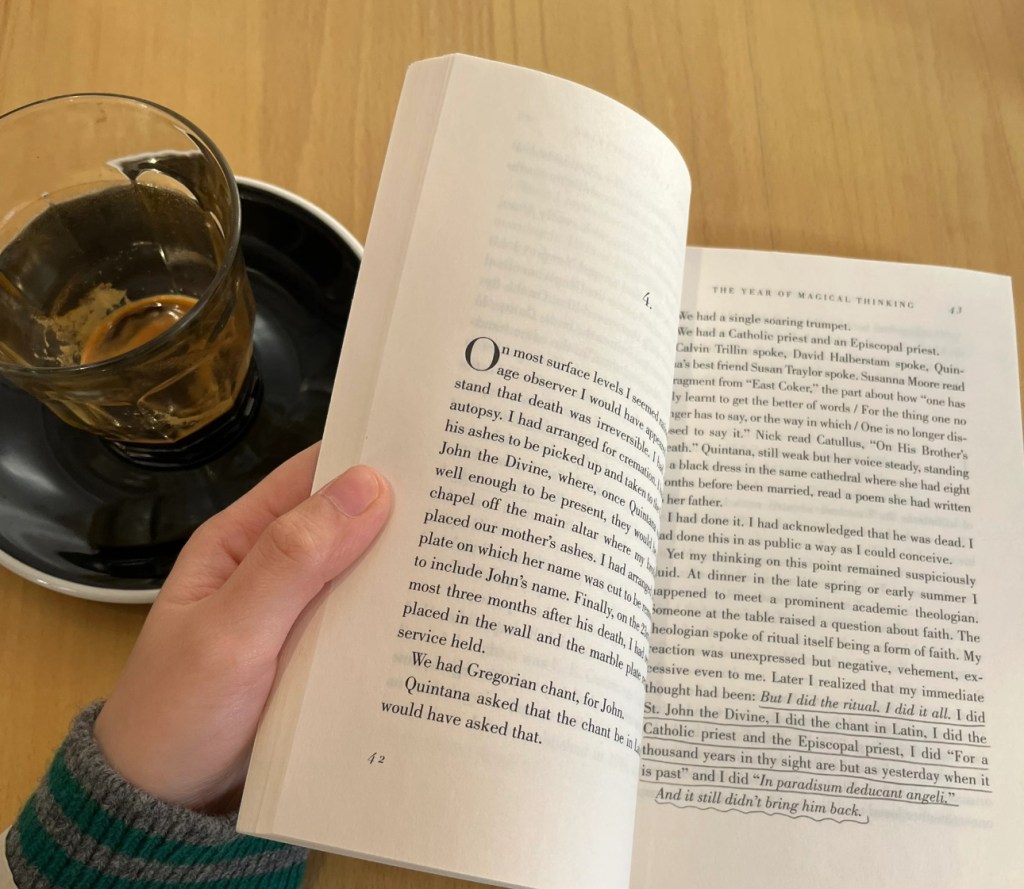
I have developed some reading and writing strategies to improve my academic work. A key strategy is to read actively, by annotating the text and summarizing the main points to ensure better understanding and memorization. For example, when reading research articles, I highlight important arguments and jot down questions in the margins. In terms of writing, I improved my outlining skills, which helped me organize my essays more effectively. I developed this skill by practicing detailed Outlines of complex assignments, making sure my arguments were coherent and sound.
- What reading and writing strategies do you need to further develop? Give examples and explain how you plan to further develop these skills.
- What readings and assignments have you enjoyed the most and why?
I think I need to further improve my critical reading and analytical writing skills. For example, when reading complex texts, I sometimes have difficulty identifying and explaining deeper themes or arguments, which can affect the strength of my written analysis. To improve, I plan to practice active reading skills, such as annotating key ideas and summarizing paragraphs to reinforce my understanding. In terms of writing, I will focus on outlining my essay more comprehensively to strengthen my argument and ensure clarity and coherence.
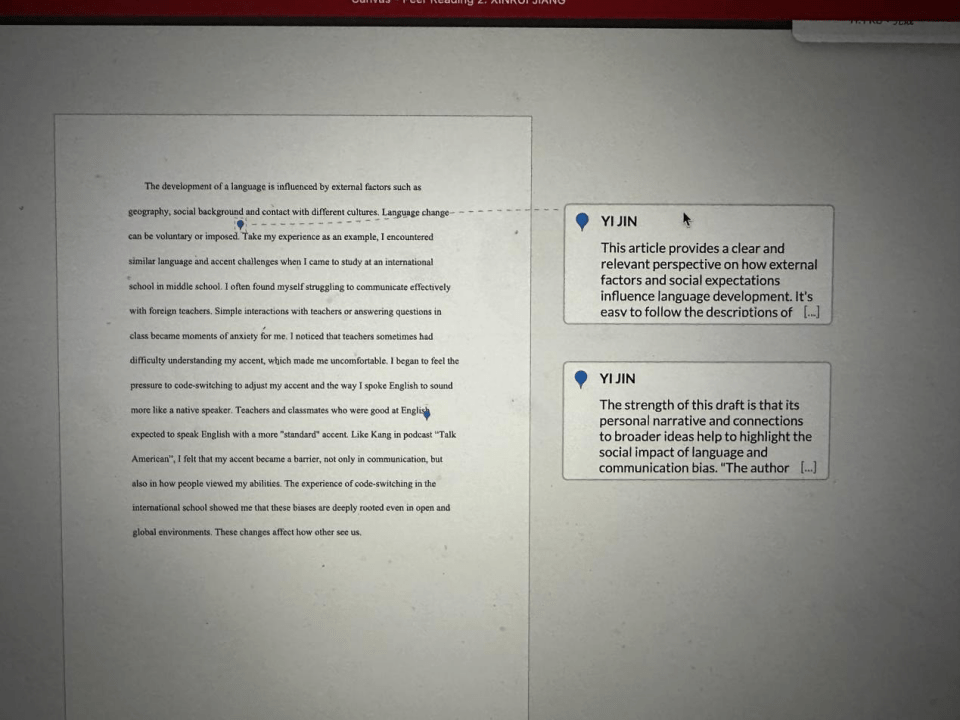
My favorite assignment is peer reading, because in the process of completion, it can help me better understand my article from different angles. After reading the comments of my classmates, I can make better changes to my article and improve my opinions and arguments. At the same time, when I make comments on students’ articles, I can re-examine the title requirements and article requirements, and then give suggestions to students. I think it’s a very meaningful homework.
- What readings and assignments have you enjoyed the least and why?
I enjoyed the discussion the least. I think that this assignment sometimes feels like the discussion lacks depth, and the responses are often superficial, making it difficult to engage in meaningful dialogue. In addition, I often feel pressure and worry about whether my opinions conform to the expectations of others, which leads to a lack of confidence and natural communication. So I feel pressure to do this homework
5.Final Reflection
Over the course of the semester, I gained valuable insights into my own writing process, my personal growth as a reader and writer, and my understanding of academic texts and their intended audiences.
First, I recognize the importance of the writing process, which includes pre-writing, drafting, revising, and finalizing. Initially, I couldn’t organize my ideas well enough, resulting in chaotic drafts. However, the process of pre-writing can help to better clarify the writing outline. At the same time, the drafting stage can help me clarify the logic and focus of the writing. For example, in the Analysis and Synthsis writing project, I set up an outline at an early stage to develop a strong thesis statement and make sure that every paragraph supports my ideas. Revision and editing is also my favorite phase, because it helps me to improve my essay, simplify the main points, and highlight the arguments. At the same time, I think the use of classmates’ feedback and teachers’ grading standards also helps me find more deficiencies in the articles and help me make progress. However, grammar is still a challenge for me, and I need to spend more time to overcome this problem and improve my article in the future.
As a reader, I realize the importance of critical thinking. Before learning EAP II, I read the literature with only a superficial understanding. But now I know that I can understand the text more deeply, through the practice of annotating the text, and the analysis of the author’s mind and words in the homework. At the same time, as a writer, I’ve learned to connect my personal experiences to broader themes that resonate with my readers. However, I am often unable to support my opinions professionally when writing, so I plan to read more academic papers in my field to learn how to build and support arguments.
One of the most challenging projects for me is the Research writing project, as I have to analyze multiple texts and synthesize them into a single argument. Because each text has its own point of view, but I need to organize these points and prove them, and I also need to form my own point of view. Instead, I chose to summarize each text, then merge similar ideas, and finally draft a paragraph that integrates them. The multimodal text introduced in the course is also very attractive to me. This improved my ability to summarize complex ideas. But video analysis is difficult for me because it requires more focus on verbal elements. Therefore, I will practice listening and body language in the future to improve my understanding. I find that the feedback from my classmates is a great help to my writing. At first, I hated being criticized. However, my classmates’ comments often provide me with a new perspective and help me make better revisions.
In preparation for my next writing class, I will continue to practice analyzing texts and expand my academic vocabulary by reading more journals. At the same time, I think the drafted steps can help me better list a clear outline, which will be helpful for my future courses. In addition, I will set aside special time for editing and proofreading to improve the quality of my writing. The skills learned in this course will help me write better professional papers and in group presentation assignments can help me clarify technical concepts to both academic and non-academic audiences.
For future students who study academic writing in EAP II class, I suggest that they actively participate in the peer review, because in this process, we can find out more of our shortcomings and unlock more possibilities. Also, it’s important to practice writing regularly and don’t hesitate to try different styles.
All in all, this course has given me a good grasp of a new skill. Writing can well help us express our opinions and pass them on. Therefore, I encourage future students to learn this skill and constantly improve themselves.
 JINYI
JINYI 